
Key takeaways
- Vietnam does not license retail CFD or forex trading. Brokers work under offshore licences and must never imply local approval.
- Demand is real but unmeasured: about 11.9 million securities accounts and around 17 million crypto holders.
- Traders find brokers through creators, KOLs and IBs on TikTok, YouTube, Facebook, Telegram and Zalo, not through ads.
- From 1 September 2026, Decree 284 fines domestic investors who trade crypto outside licensed providers, putting USDT funding under pressure.
- After the Mr Pips fraud, the broker that looks least like a scam has the edge.
Vietnam is one of the most talked-about CFD markets in Asia and one of the least documented. You won't find a regulator's trader count or a local licence, and nobody publishes market share. What you will find is millions of mobile-first retail investors, a deep gold culture, a crypto community that already trades offshore, and a public that learned the word "forex" from fraud headlines.
This guide puts everything a broker needs on one page. Each section stands on its own and links to a deeper article or service page where one exists. It reflects how A Tiny Planet works with CFD brokers, forex platforms and crypto exchanges entering Vietnam, and it is market commentary, not legal advice.
What does the Vietnam CFD market look like in 2026?
The Vietnam CFD market is an offshore market served from abroad, sold through people, and shaped by trust. Three facts define it.
First, there is no local licence. Every broker serving Vietnamese clients operates under a licence from another jurisdiction. Second, demand is large and growing: retail investing exploded in 2025, with a record 2.5 million new securities accounts. Third, the public image of forex is set by scams, above all the Mr Pips case in which Hanoi police seized about VND 5.3 trillion (around USD 201 million).
| Dimension | What it looks like in Vietnam |
|---|---|
| Regulation | No retail CFD or forex licence; offshore brokers only |
| Demand signals | About 11.9 million securities accounts, around 17 million crypto holders |
| Gateway product | Gold (XAUUSD), in our experience |
| Discovery | TikTok, YouTube, Facebook, finance creators |
| Trust and conversion | Telegram and Zalo groups, KOLs, introducing brokers |
| Main risks | Payment friction, ad rejections, fraud-driven enforcement waves |
If you only remember one thing: Vietnam rewards brokers who treat it as a long trust-building project, and punishes the ones who treat it as a traffic arbitrage. Our market read on CFD trading in Vietnam covers size and legal status in more depth.
Is CFD trading legal in Vietnam?
Retail CFD trading in Vietnam is unlicensed but not clearly banned for individuals who use offshore brokers. The State Bank of Vietnam does not license retail forex or CFD platforms, and only licensed banks and authorised institutions may conduct foreign-currency trading inside the country.
In practice, the grey zone looks like this:
- Brokers. There is no Vietnamese licence to apply for. Brokers serve the market under licences from other regulators.
- Traders. Individuals who trade offshore are not clearly breaking a specific law, but they get no local investor protection.
- Banks. Outward transfers for margin trading are not an approved purpose, and banks can question or block them.
- Websites. One major CFD broker had its local .vn domain blocked by VNNIC at police request.
- Enforcement. So far it targets fraud networks, in waves, rather than licensed offshore brokers.
The Finance Magnates analysis from November 2025 summed it up: expect continued enforcement in waves tied to fraud cases, rather than a near-term crackdown.
For marketing, one rule follows: show the regulators you are actually licensed by and nothing that suggests approval from a Vietnamese authority. Get a local legal opinion before you commit budget. We list the full set of compliance limits in our guide to marketing a CFD broker in Vietnam.
How big is the CFD market in Vietnam?
Nobody has a verified count of CFD traders in Vietnam, so you have to size the market from the pools it draws on. The two best proxies are the securities market and the crypto community.
| Proxy | Figure | Source |
|---|---|---|
| Securities trading accounts | About 11.9 million at end-2025, up 21% in the year | VSDC data via Hanoi Times |
| New securities accounts, 2025 | A record 2.5 million | VSDC data via Hanoi Times |
| Accounts held by individuals | 99.8% | VSDC, May 2025 |
| Crypto holders | Around 17 million, peaking near 21 million | Government-cited estimates |
| Crypto transaction volume, Jul 2024 to Jun 2025 | USD 220 to 230 billion | Chainalysis, cited by the government |
| Global crypto adoption rank, 2025 | 4th | Chainalysis |
| Active social media identities | 79.0 million (October 2025) | DataReportal, Digital 2026 |
How we use these numbers: start from the stock and crypto pools, then cut hard. Most of those people will never open an offshore leveraged account, and many who do will trade small. A plan built on "17 million potential clients" will overspend in month two.
Be careful with precise trader counts that circulate in broker marketing. If a figure has no primary source, treat it as a guess. The CFD trading in Vietnam article walks through each proxy.
Who is the Vietnamese CFD trader?
The Vietnamese CFD trader is usually mobile-first, learns from creators, and trusts a person before a brand. Beyond that, we see four recurring profiles in our campaigns, and each needs a different message.
| Profile | Where they come from | What pulls them to CFDs | What they need from you |
|---|---|---|---|
| The stock trader stepping up | Vietnamese equities apps | Leverage, two-way trading, US indices | Clear explanation of margin and risk |
| The crypto native | Offshore crypto exchanges | 24-hour markets, familiar volatility | Fast funding and withdrawals |
| The gold buyer | Physical gold, SJC bars | Trading gold without the premium or storage | Simple XAUUSD education |
| The group follower | Telegram or Zalo signal groups | A trusted admin or KOL | A partner who stays accountable |
The group follower is the profile scam networks target most, and the one regulators worry about most. Treat it carefully. If your growth depends on signal groups making promises, you are building on the same ground that brought down Mr Pips.
You reach each profile with different creators and different content. That is why our KOL and IB programmes start with audience mapping, not follower counts.
Why is gold the gateway product for CFD traders in Vietnam?
Gold is the gateway because Vietnamese households already trust it, follow its price daily, and pay a premium to own it physically. In our campaigns, XAUUSD is the most common first instrument, well ahead of forex pairs.
The domestic gold market explains why. For years SJC held a monopoly on gold bar production, and domestic prices ran far above world prices. In August 2025 the premium on bars was more than VND 20 million per tael above the converted world price. Decree 232/2025, effective 10 October 2025, ended the state monopoly on bar production and imports, and the gap has narrowed since, though it has not closed.
What this means for your marketing:
- Gold content already has an audience. Explaining the difference between world gold and domestic bar prices is useful, compliant education.
- Never frame XAUUSD as a substitute for owning gold. A CFD gives price exposure, not metal, and leverage changes the risk completely.
- Time your gold content around price moves. Interest jumps when domestic prices hit records, as the 2025 gold rush in Ho Chi Minh City showed.
Gold is also where brokers get into trouble. A creator who says "gold only goes up" on your behalf is a compliance problem, however well the video performs.
Which channels do Vietnamese traders use to find a broker?
Vietnamese traders discover brokers on TikTok, YouTube and Facebook, and decide in Telegram and Zalo groups. Search matters at the point of intent, when a trader is already comparing names.
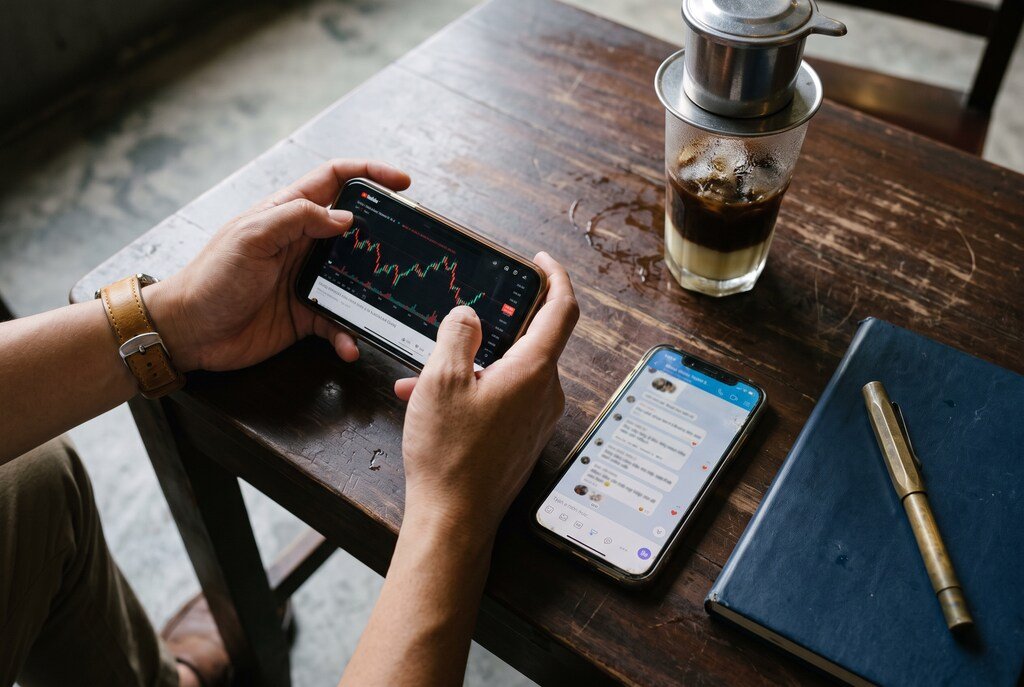
The scale is large. DataReportal counted 79.0 million active social media identities in Vietnam in October 2025. We Are Social's Vietnam 2025 data shows users spending more than 41 hours a month on TikTok and more than 20 on Facebook, and a Decision Lab study put Zalo's penetration at 85%.
| Stage | Channel | Role | What to measure |
|---|---|---|---|
| Discovery | TikTok, YouTube, Facebook | Education, creator videos | Qualified views, profile visits |
| Consideration | Telegram, Zalo groups | Trust, Q&A, community | Group growth, active members |
| Intent | Google Search, comparison pages | Brand defence, reviews | Branded search, sign-ups |
| Conversion | Landing pages, Vietnamese sales chat | Onboarding, first deposit | Verified accounts, first deposits |
| Retention | Telegram, Zalo, email, app | Education, support | 30- and 90-day active traders |
Plan these as one funnel, not five campaigns. The handover between stages, especially from a creator's video to your Telegram or landing page, is where most leads get lost. The channel map in our guide to marketing a CFD broker in Vietnam goes into each stage.
Can you advertise CFDs on Google, Meta and TikTok in Vietnam?
You can advertise around CFDs in Vietnam, but direct CFD ads face restricted-product rules and frequent reviews. Google lists contracts for difference, rolling spot forex and financial spread betting as restricted speculative products under its financial products and services policy, and it can require financial services verification separately for each country you target. Meta and TikTok apply their own financial-services rules.
The approach that holds up in practice:
- Lead with education. Market explainers, platform tutorials and risk education pass review far more often than product offers.
- Never promise returns. No profit claims, no "guaranteed" signals, no lifestyle imagery that implies easy money.
- Keep a Vietnamese risk warning on every ad, landing page and partner post.
- Prepare backup creative and accounts. Reviews happen. A campaign that dies with one rejected ad was never ready.
- Measure to the first deposit. Cheap leads that never fund are the most expensive thing in this market.
Paid media works best in Vietnam as an amplifier for creator content and brand search, not as the main engine. Our performance marketing work is built around that split.
How do KOL and IB programmes work for CFD brokers in Vietnam?
KOL and IB programmes are the main acquisition engine for CFD brokers in Vietnam, because traders follow people before brands. In its November 2025 report, Finance Magnates noted that most onboarding in Vietnam happens through affiliates and introducing brokers.
The two roles are different:
| KOL (finance creator) | IB (introducing broker) | |
|---|---|---|
| Main job | Reach and education | Client relationships and onboarding |
| Paid by | Campaign fee, sometimes CPA | Rebates or revenue share on client trading |
| Biggest risk | Non-compliant claims in viral content | Pushing clients to overtrade |
| Measure on | Qualified traffic, verified accounts | First deposits, 90-day active clients |
What separates programmes that grow from ones that burn budget:
- Vet before you sign. Check past promotions, community reputation and any link to signal schemes.
- Brief in writing. Education first, no profit promises, a visible risk warning, and the right to pull content.
- Track each partner separately with unique links, codes and CRM tags.
- Pay for quality. Reward verified accounts and active traders, not clicks or follower counts.
- Exit fast when a partner's audience never funds or their content turns risky.
An IB who builds a client base through aggressive promises can take your brand down with them when the next fraud case breaks. We run vetting and tracking as part of our KOL and IB partnership service, and the Vietnam forex market entry guide shows where partners sit in the funnel.
How do Vietnamese traders fund CFD accounts, and what changed with Decree 284?
Vietnamese traders typically fund offshore accounts by local bank transfer through payment agents, e-wallets, or USDT bought on peer-to-peer crypto markets. Each route carries friction, and since 1 September 2026 the crypto route carries new legal risk.
Decree 284/2026/ND-CP, issued in July 2026, sets fines for crypto-asset violations under the pilot market created by Resolution 05/2025/NQ-CP. As reported by The Block, domestic investors who trade crypto outside providers licensed by the Ministry of Finance face fines of VND 30 to 50 million, and unlicensed crypto services or advertising face fines of up to VND 200 million. At the time, no exchange had yet been licensed, which may delay enforcement.
| Funding route | Why traders use it | What to watch |
|---|---|---|
| Local bank transfer via payment agents | Familiar, works in VND | Banks can question transfers linked to margin trading |
| E-wallets | Fast, mobile | Availability changes; check each provider |
| USDT via P2P markets | Already used by crypto traders | Decree 284 fines for trading crypto outside licensed providers; P2P scams and frozen bank accounts |
Our view: don't build your Vietnam growth plan on a single funding route, and don't market USDT funding as a headline feature. Whether crypto CFDs or USDT deposits fall within Decree 284 is a question for your Vietnamese lawyer. Ask it before launch, not after the first enforcement wave.
Withdrawals matter even more than deposits. In a market scarred by fraud, a fast, boring withdrawal is your best advertisement.
What does localization mean for a trading product in Vietnam?
Localization for a trading product in Vietnam means using the words Vietnamese traders actually say, in every screen, script and support reply. A machine-translated onboarding flow loses traders at the moments that matter most: verification and the first deposit.
Some terms stay in English, because that is how traders talk. Others need the natural Vietnamese term:
| English | What Vietnamese traders say |
|---|---|
| Spread, pip, lot, swap | Spread, pip, lot, swap (kept in English) |
| Leverage | Đòn bẩy |
| Margin | Ký quỹ |
| Stop Loss / Take Profit | Cắt lỗ / Chốt lời |
| Slippage | Trượt giá |
| Spread widening | Giãn spread |
| Overnight fee | Phí qua đêm |
| Negative balance protection | Bảo vệ số dư âm |
Three things to agree before you translate anything: a shared glossary, a tone of voice (how you address the trader, "bạn" or something more formal), and who signs off on risk warnings. Then apply them everywhere: app, website, support macros, sales scripts and partner briefs. Our brand localization team builds the glossary first for exactly this reason.
How do you build trust as a new CFD broker in Vietnam?
You build trust in Vietnam by visibly doing the opposite of what scam networks do. The Mr Pips case, in which police said they would investigate around 550 sales staff, taught Vietnamese traders to look for specific warning signs: profit promises, pushy calls, "guaranteed" signals, and withdrawals that stall.
| Scam pattern traders now recognise | What a trustworthy broker does instead |
|---|---|
| Promises of fixed profits | Education and risk warnings, no return claims |
| Aggressive sales calls | Support that answers questions, then lets the trader decide |
| Vague or invented licences | Clear statement of the actual regulators, nothing more |
| Withdrawal delays | Fast, documented withdrawals |
| Anonymous "experts" | Named partners with a reputation to protect |
Here's our honest view after working in this market: in Vietnam, looking less like a scam is worth more than any welcome bonus. Bonuses attract the traders who leave first. Proof of fast withdrawals and visible, accountable partners attract the ones who stay.
The CFD trading in Vietnam article covers how the Mr Pips case reshaped trader behaviour.
What does a realistic 12-month Vietnam entry plan look like?
A realistic Vietnam entry plan runs in four phases over about 12 months, with a decision point at the end of each. You commit more budget only when the previous phase proves itself.

| Phase | Timing | Main work | Decision point |
|---|---|---|---|
| 1. Discover | Months 1–2 | Legal opinion, payment routes, competitor and creator mapping | Is there a compliant path for your product? |
| 2. Strategise | Months 2–3 | Positioning, glossary, channel mix, partner shortlist, KPIs | Which two or three channels go first? |
| 3. Launch | Months 3–6 | Localized product and site, first KOL and IB partners, education content, search | Are verified accounts turning into first deposits? |
| 4. Optimise | Months 6–12 | Partner reviews, retention programme, budget moves | Which partners and channels bring traders who stay? |
The brokers we see waste the most money in Vietnam skip phase one. They buy traffic in month one and discover in month three that ads get rejected, funding fails and the sales team can't answer basic questions in Vietnamese.
Our Vietnam market entry service runs these four phases with one senior-led team. If you're sizing up Vietnam for 2027, send us a short brief and we'll tell you where the market is realistic for your product, and where it isn't.
Resources for brokers entering Vietnam
Our articles
- CFD trading in Vietnam: market size, legal status and what to expect
- How to market a CFD broker in Vietnam
- Vietnam CFD and forex market entry guide
Our services
External sources
- Finance Magnates: Vietnam busts USD 200M forex scam (November 2025)
- Google Ads: financial products and services policy
- DataReportal: Digital 2026 Vietnam
- Decree 284/2026/ND-CP, bilingual text (LuatVietnam)
- Watson Farley & Williams: Vietnam's digital assets legislation
FAQ
Is CFD trading legal in Vietnam?
Vietnam does not license retail CFD trading, but individuals who use offshore brokers are not clearly breaking a specific law. Authorities so far act against fraud networks rather than licensed offshore brokers. Banks can still question transfers linked to margin trading, so the practical limits are real even where the law is unclear.
Can a foreign broker get a CFD licence in Vietnam?
No. As of 2026, Vietnam has no licence for offering retail CFDs or forex to local clients, for domestic or foreign firms. Brokers serve Vietnamese traders under licences from other regulators. Marketing must name those real regulators and never imply approval from the State Bank of Vietnam or any Vietnamese authority.
How many CFD traders are there in Vietnam?
There is no official figure. The closest proxies are about 11.9 million securities accounts at the end of 2025 and around 17 million crypto holders. CFD traders are a small subset of these pools, usually people looking for leverage, gold or 24-hour markets. Treat any precise trader count without a primary source as a guess.
What do Vietnamese traders trade most on CFD platforms?
In our campaigns, gold (XAUUSD) is the most common first instrument, followed by major forex pairs and US indices. Gold already carries deep cultural trust in Vietnam and its domestic price is followed daily, so new CFD traders often start there. Crypto CFDs appeal mostly to traders who already hold coins on offshore exchanges.
Does Decree 284 affect forex and CFD brokers?
Decree 284/2026 targets crypto-asset trading and services outside Ministry of Finance-licensed providers, with fines from 1 September 2026. It does not mention CFDs. But traders who fund offshore accounts with USDT bought on P2P markets may be exposed, and brokers promoting crypto services face risk. Get a Vietnamese legal opinion on your setup.
How do Vietnamese traders choose a CFD broker?
Most choose through someone they already follow: a finance creator, a Telegram or Zalo group admin, or an introducing broker. They discover brokers on TikTok, YouTube and Facebook, then check reputation in community groups. Fast withdrawals and Vietnamese-speaking support decide whether they stay beyond the first deposit.
CFDs are complex instruments and carry a high risk of losing money rapidly due to leverage. This guide is market commentary for businesses, not legal or investment advice.